for the public
for scientists
Globular star clusters are collections of hundreds of thousands to millions of stars which are almost as old as the universe itself. Roughly two hundred globular clusters orbit around the Milky Way.
Because globular star clusters pack so many stars into a small space, stars often come very close to each other. This makes them into factories for some exotic systems which are very rare elsewhere in the universe.
Globular clusters are old, dense stellar environments in which dynamical interactions are common. The Milky Way contains roughly two hundred globular clusters in its halo.
Frequent few-body interactions in globular clusters make them prime locations for the formation of exotic objects which are rare in the field. This includes low-mass X-ray binaries, millisecond pulsars, and possibly many binary black holes.
compact objects in globular clusters
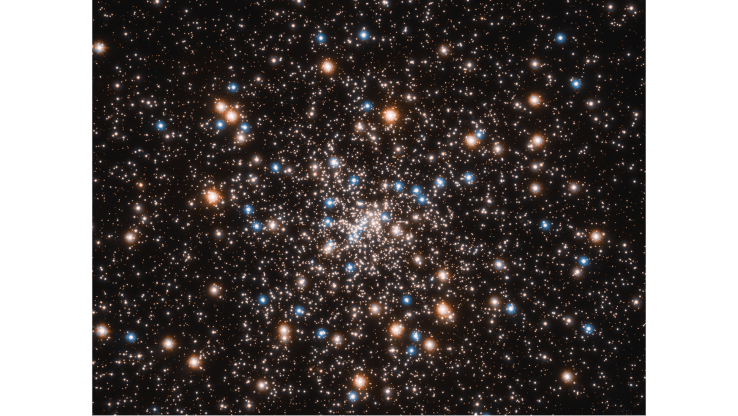
The way that a globular star cluster looks like today depends on what stars make it up. Some “cored” star clusters appear to have flat brightnesses at their centers, since their cores contain many black holes. Other “core-collapsed” star clusters have brightnesses which keep rising towards the center, since there are no black holes to kick the stars out of their centers.
My work has made it easier for astrophysicists to compare simulations of globular star clusters to data. Since we know what kinds of stars are in our simulations, we can infer what kinds of stars are in globular clusters even if we can’t see all of them individually.
We discovered that core-collapsed globular star clusters have many white dwarfs at their centers. These are dead stars which are about as heavy as the Sun but crammed into a ball the size of the Earth. Because they are so heavy, they sink to the center of their star clusters. Because white dwarfs are hard to see, this discovery explains the observation that the globular cluster NGC 6397 seems to have a swarm of invisible, heavy objects in its core, even though it shouldn’t have any black holes.
Globular clusters can be categorized as cored or core-collapsed, depending on whether their surface brightness profiles become flat or monotonically rise towards their centers. The distinction between these classes arises from whether the globular cluster has retained a significant population of black holes. When present, these black holes segregate to the core due to dynamical friction and provide dynamical heating.
I have developed a Python package called cmctoolkit, which interfaces with the Hénon-style star cluster code Cluster Monte Carlo. Using this package, I matched a significant number of observed globular cluster to dynamical models from the CMC Cluster Catalog based on surface brightness and velocity dispersion profiles.
We show that core-collapsed clusters contain significant fractions of white dwarfs. In the absence of black holes, white dwarfs segregate to their cluster cores and dominate the population. This explains recent observations of a diffuse subcluster of dark objects at the core of NGC 6397, which is core-collapsed.
cmctoolkit can be downloaded at the Github repository NicholasRui/cmctoolkit.
presented at:
- 2022 Aspen Winter Conference: Dynamical Formation of Gravitational Wave Sources (Aspen, Colorado, January 2022), slides
published as:
- Kremer, K., Rui, N. Z., Weatherford, N. C., Chatterjee, S., Fragione, G., Rasio, F. A., … & Ye, C. S. (2021). White dwarf subsystems in core-collapsed globular clusters. The Astrophysical Journal, 917(1), 28.
- Rui, N. Z., Weatherford, N. C., Kremer, K., Chatterjee, S., Fragione, G., Rasio, F. A., … & Ye, C. S. (2021). No Black Holes in NGC 6397. Research Notes of the AAS, 5(3), 47.
- Rui, N. Z., Kremer, K., Weatherford, N. C., Chatterjee, S., Rasio, F. A., Rodriguez, C. L., & Ye, C. S. (2021). Matching Globular Cluster Models to Observations. The Astrophysical Journal, 912(2), 102.
- Kremer, K., Claire, S. Y., Rui, N. Z., Weatherford, N. C., Chatterjee, S., Fragione, G., … & Rasio, F. A. (2020). Modeling Dense Star Clusters in the Milky Way and Beyond with the CMC Cluster Catalog. The Astrophysical Journal Supplement Series, 247(2), 48.
 Nicholas Rui